

"In any moment of decision, the best thing you can do is the right thing, the next best thing is the wrong thing, and the worst thing you can do is nothing." Theodore Roosevelt
RIGHT DECISIONS
Decision-making is the process of identifying, evaluating, and choosing the most appropriate option from two or more alternatives in order to achieve a desired objective. It involves considering available information, as well as the values, preferences, beliefs, and priorities of the decision-maker. Every decision-making process ultimately results in a choice. It is important to understand the difference between problem-solving and decision-making. Problem-solving is the process of identifying a problem and looking for possible solutions. Decision-making is the process of reviewing available options, evaluating their potential outcomes, and making a choice.
Challenges in Decision-Making
The decision-making process can sometimes become frustrating and overwhelming. When faced with too much information, uncertainty, or pressure, we may experience different mental and emotional states that make it difficult to move forward.
Analysis Paralysis: This occurs when we are unable to make a decision because we become overwhelmed by the amount of information available or spend too much time analyzing every detail. Instead of helping us make a choice, excessive analysis prevents us from moving forward.
Decision Fatigue: Decision fatigue occurs when we make or think about too many decisions over an extended period of time. As our mental energy decreases, it becomes more difficult to evaluate options clearly and make effective decisions.
Indecisiveness: Indecisiveness occurs when we struggle to make a choice, often because of uncertainty, fear, or concern about making the wrong decision.
Methods for Analyzing Decisions
There are several methods that can be used to analyze and evaluate decisions. Each method provides a different framework for comparing alternatives and identifying the most appropriate course of action.
Decisional Balance Sheet: A decisional balance sheet involves listing the advantages and disadvantages of each option. This can include benefits and costs, as well as the pros and cons associated with each alternative. This approach has historical roots in the work of Greek philosophers such as Plato and Protagoras and was also used by Benjamin Franklin, one of the Founding Fathers of the United States.
Options Generation: Options generation involves identifying and considering a wide range of possible alternatives before making a decision. Rather than immediately choosing between a few existing options, this approach encourages the decision-maker to develop additional possibilities and then evaluate them to determine which alternative best meets the desired objectives.
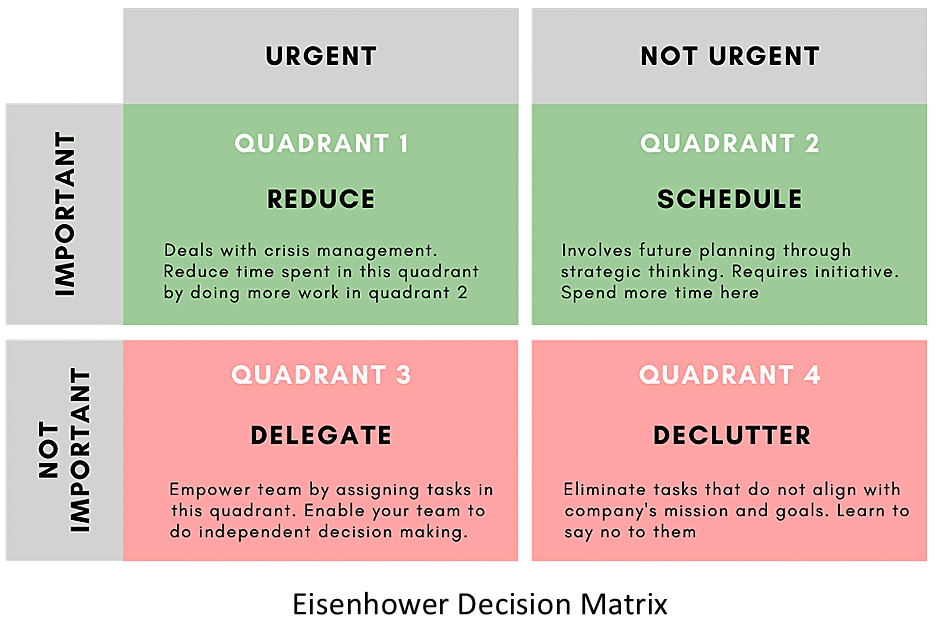
Eisenhower Decision Matrix: The Eisenhower Decision Matrix is a framework for prioritizing tasks and decisions based on two factors: urgency and importance. Dwight D. Eisenhower, the 34th President of the United States and Supreme Commander of the Allied Expeditionary Force in Europe during World War II, is commonly associated with the distinction between important and urgent tasks. The framework divides decisions or tasks into four categories:
Not important and not urgent: Consider eliminating or minimizing these activities.
Important but not urgent: Prioritize and schedule these activities.
Urgent but not important: Consider delegating these activities when possible.
Urgent and important: Address these activities immediately.
Expected-Value Optimization: Expected-value optimization involves selecting the alternative with the highest probability-weighted expected utility. In other words, the decision-maker considers both the potential outcomes of each alternative and the probability that those outcomes will occur. This approach may also account for risk aversion, reflecting how willing a person or organization is to accept uncertainty or potential losses. It can also involve considering the opportunity cost of each alternative—the potential benefits that are forgone by choosing one option instead of another.
Pareto Principle (80/20 Rule): The Pareto Principle, commonly known as the 80/20 rule, states that, in many situations, approximately 80% of the effects result from 20% of the causes. Italian economist Vilfredo Pareto observed this relationship in the distribution of wealth and property. While studying at the University of Lausanne, Pareto noted that approximately 80% of the land in Italy was owned by 20% of the population. He described this distribution in his work Cours d'économie politique, published in 1896. The principle is often used in decision-making to identify the relatively small number of factors that may have the greatest impact.
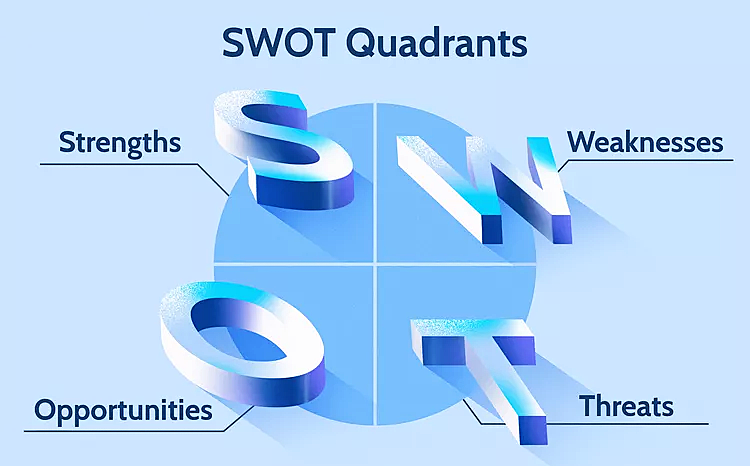
SWOT Analysis: SWOT stands for Strengths, Weaknesses, Opportunities, and Threats. It is a framework used to examine both internal and external factors that may affect a decision, organization, project, or strategy.
Strengths: Internal advantages or capabilities. These are areas in which you perform well or resources and capabilities that you already possess.
Weaknesses: Internal limitations or disadvantages. These are areas that require improvement or factors that may put you at a disadvantage.
Opportunities: External circumstances that could provide potential benefits. These are factors outside the organization or individual that could be leveraged to achieve desired objectives.
Threats: External circumstances that could create problems or risks. These are factors outside the organization or individual that could negatively affect the desired outcome.
Ethical Behavior
Ethics is the study of what is morally right and wrong and how people ought to behave. It provides principles and values that guide our decisions, choices, and actions. Every decision we make should be grounded in ethical principles and positive values. When positive values are absent, we lack clear direction. We can become distracted by things that are unimportant, lose sight of our purpose, and make decisions that are inconsistent with ethical behavior. When positive values are present, they help define who we are, give us a sense of purpose, and guide our behavior. Our values influence how we think, how we respond to situations, and ultimately the choices we make. Values also shape culture, identity, ethos, and belief systems. They establish the standards by which individuals and organizations determine what is right and wrong and provide a framework for making ethical decisions. Examples of positive values include positivity, discipline, decisiveness, agility, resilience, and integrity. These values help individuals remain focused, accountable, adaptable, and committed to doing what is right.
Certainty
Certainty is the feeling of being completely free from doubt. Yet the reality is that we can only control the decisions we make and not the outcomes that follow. We often want our decisions to be failproof. We worry because we seek certainty, an absolute guarantee that things will turn out the way we hope. But certainty does not truly exist. Every outcome is influenced by external factors, many of which are beyond our control. What we can control is how thoughtfully we make our decisions and how we respond when circumstances change. We must do our best to make the best decision with the information we have, then remain agile, adaptable, and willing to adjust as new information emerges.
Primary factors
There are three primary factors that influence decision-making:
Rational: Relies on logic, objective information, and structured analysis, such as weighing the pros and cons.
Intuitive: Relies on instinct, experience, or a “gut feeling” rather than extensive analysis.
Emotional: Driven primarily by current feelings, personal values, and individual preferences.
Process of Decision-Making
Identify the Problem: Clearly define the challenge, issue, or goal that needs to be addressed.
Gather Information: Collect relevant facts, data, and information needed to understand the situation.
Identify Alternatives: Explore and list the possible options, choices, or solutions available.
Evaluate Alternatives: Assess each option by considering its advantages, disadvantages, costs, risks, and potential outcomes.
Choose the Best Alternative: Select the option that most effectively supports the desired goal and provides the best overall outcome.
Make the Decision: Commit to the selected course of action and clearly define the next steps.
Implement the Decision: Put the decision into action and ensure the necessary resources and responsibilities are in place.
Review the Results: Periodically assess progress and determine whether the decision is achieving the desired outcomes.
Adjust as Needed: Remain flexible and make appropriate changes when circumstances change or the results indicate that adjustments are necessary.
WHAT ARE DECISIONS
To get started, step away from your office or home and find a place where stress is minimal.
Take a pen and paper and write down your thoughts.
Start by listening to the audio session, then watch the short video(s).
PREPARATION
GUIDED SESSION

Use headphones for optimal sound
The development of decision-making. James P Byrnes Ph.D. Journal of Adolescent Health. V.31, Issue 6. P. 208-215. 2002.
The theory of decision making. Edwards, Ward. Psychological Bulletin, 51(4), 380–417. 1954.
How Can Decision Making Be Improved? Katherine L. Milkman, et.al. Perspectives on Psychological Science. V. 4, Issue 4. 2009.
Decision Making. J. Frank Yates, et.al. A Companion to Cognitive Science. 2017
Strategic decision making. Kathleen M. Eisenhardt, et.al. Strategic Management Journal. V. 13, Issue S2. P. 17-37. 1992.
Culture and decision making. J. Frank Yates, et.al. Organizational Behavior and Human Decision Processes. V. 136. P. 106-118. 2016.